Community mobilization committees
- Country: Côte d’Ivoire
- Published on: 5 December 2025
- Author: Florine Maréchal
As part of the Women and Cocoa Communities Initiative (IFCC) in Côte d’Ivoire funded by Global Affairs Canada, Socodevi and the Fondation Paul Gérin-Lajoie are implementing an innovative strategy to improve living conditions in rural areas, particularly for women and adolescent girls.
The crux of this strategy is the community mobilization committee, a powerful tool for identifying local issues and establishing concrete solutions together, tailored to each community’s needs.
Committees that mobilize and drive social change
Community mobilization committees have been established in 62 communities and are made up of 5 to 9 members from all walks of life: chieftainship members, young people, female leaders and mentors, literacy educators, etc. Together, they work to raise awareness and bring their community together around the rights of girls and women.
More specifically, mobilization committees are designed to:
- Promote the rights of women and girls
- Support education, especially for girls
- Raise awareness about gender equality and preventing gender-based violence
- Encourage the economic empowerment of women
- Mobilize local resources to support community initiatives

Building local capacity to solve community issues
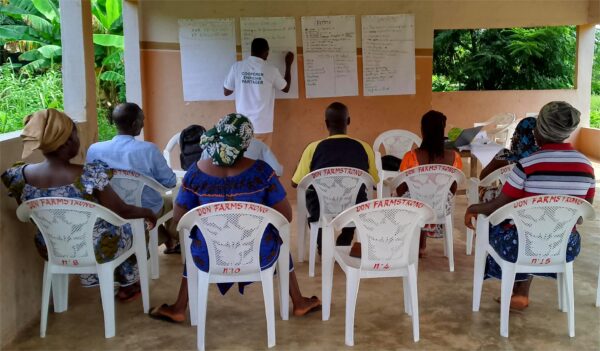
Hermann Yao, WCCI project facilitator, recently led a crucial training for the various committees.
“Our goal was to develop their skills in gender equality, positive masculinity and education,” he explains. “Through role-playing and participatory exercises, members were able to identify barriers to girls’ schooling and propose concrete solutions.”
One of the major obstacles identified during this training was the lack of birth certificates, which prevents children from taking the primary school exam (end of Grade 5) and continuing their studies. Members took this roadblock to heart and committed to raising awareness among families about the importance of civil registration.
The training distinguished between biological differences and social constructs and highlighted how women’s empowerment would benefit the community, leaving participants with a better understanding of gender inequality.
Voices raised for change
A story of resilience: Émilie Kona Ahou, president of the Village Savings and Loan Association in the village of Obrouayo
“I had to stop school at Grade 5 because my parents didn’t have my birth certificate and school supplies were hard to come by. Today, thanks to literacy classes, I can read and write. But had I had my birth certificate, I could have earned my primary school diploma and maybe even worked in an office in the city.”
A personal commitment to equality: Fabrice Godo, youth office secretary for the village of Sayo
“I am a member of the community mobilization committee and I am proud to be helping make change in my village! Before the training, I thought that there were more than just biological differences between men and women, but now I know that everyone has the same rights. As a man and a leader, I am committed to raising awareness among my peers so that women can access land and participate in decisions, and girls can finish their schooling.”
Encouraging participation and inclusion
“What’s remarkable is the participants’ dedication to becoming agents of change,” says Hermann. “They committed to reaching out to their peers to do advocacy and awareness-raising work on each topic.”
These committees are now an essential go-between for the WCCI and local communities. The committees help implement the WCCI’s work, while contributing to its long-term success by promoting local ownership of issues related to education, equality and economic development.
Sustainable, community-driven change
Community mobilization committees show that change is not just enacted by institutions, but also, more importantly, by community members who take charge and take action on issues to transform their daily lives. Thanks to their hard work, a real movement of awareness, inclusion and hope is underway in the cocoa-growing communities of Côte d’Ivoire.
This article was written in collaboration with the Fondation Paul Gérin-Lajoie communications team.


